
Few situations test an agency like taking over an account that loses money every month and then gets suspended weeks into the engagement. This case study covers the 25 months we spent rebuilding it into a multi-market, profitable operation.
Few situations test an agency like taking over an account that loses money every month and then gets suspended weeks into the engagement. This case study covers the 25 months we spent rebuilding it into a multi-market, profitable operation.
We took over the account at the beginning of May, two years ago. Our client is a European bedding brand that sells across eight Amazon EU marketplaces, with Germany as its primary market. The products sit at a premium price point in a niche full of lower-cost alternatives, so margin protection and ranking strength matter more than in most categories.
We took over the account at the beginning of May, two years ago. Our client is a European bedding brand that sells across eight Amazon EU marketplaces, with Germany as its primary market. The products sit at a premium price point in a niche full of lower-cost alternatives, so margin protection and ranking strength matter more than in most categories.
We took over the account at the beginning of May, two years ago. Our client is a European bedding brand that sells across eight Amazon EU marketplaces, with Germany as its primary market. The products sit at a premium price point in a niche full of lower-cost alternatives, so margin protection and ranking strength matter more than in most categories.
We took over the account at the beginning of May, two years ago. Our client is a European bedding brand that sells across eight Amazon EU marketplaces, with Germany as its primary market. The products sit at a premium price point in a niche full of lower-cost alternatives, so margin protection and ranking strength matter more than in most categories.

Two problems were waiting for us when we onboarded.
Structural losses, with no campaign architecture underneath them
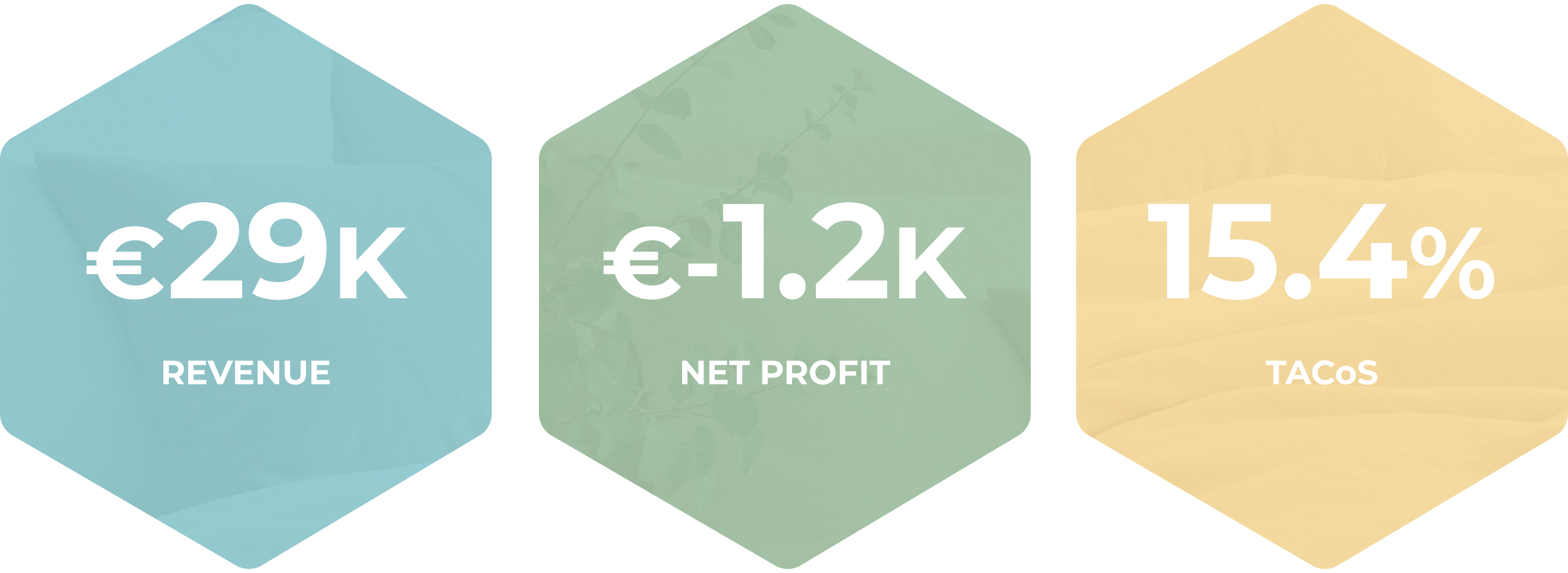
The account had been bleeding money for months before we arrived. A month before we started, EU-level revenue came in at €29,256, a -4% profit margin, and €1,206 loss.
Once we got into the campaigns, we saw why. Every duvet variation the brand sells, across different warmth ratings, sizes, and seasonal types, sat in the same campaigns with no segmentation by product type or feature. There were no portfolio structures to separate the budget by category or season, so there was no way to see where the ad spend went or control it at the category level.
The deeper problem was lying in keyword targeting, which had never been mapped to product relevance. Shoppers searching for one size kept landing on another. The account paid for every one of those clicks, and most of them never had a chance to convert.
Account suspension in Month 2
During our 2nd month, Amazon suspended the account over a missed business document verification deadline, which was initiated before we took over. Unfortunately, in the first few months, we did not have access to the identity verification portal. The account was offline for most of month 2 and nearly all of month 3. When selling rights came back at the end of the 3rd month, we had seven trading days left for the period and a summer season slipping away.
Those seven days produced €17,320 in revenue at a -50% gross margin, and it took €13,400 in ad spend just to get the wheels turning again. The organic momentum the account once had was gone, and we were rebuilding from zero in the middle of the season.
Two problems were waiting for us when we onboarded.
Structural losses, with no campaign architecture underneath them
The account had been bleeding money for months before we arrived. A month before we started, EU-level revenue came in at €29,256, a -4% profit margin, and €1,206 loss.
Once we got into the campaigns, we saw why. Every duvet variation the brand sells, across different warmth ratings, sizes, and seasonal types, sat in the same campaigns with no segmentation by product type or feature. There were no portfolio structures to separate the budget by category or season, so there was no way to see where the ad spend went or control it at the category level.
The deeper problem was lying in keyword targeting, which had never been mapped to product relevance. Shoppers searching for one size kept landing on another. The account paid for every one of those clicks, and most of them never had a chance to convert.
Account suspension in Month 2
During our 2nd month, Amazon suspended the account over a missed business document verification deadline, which was initiated before we took over. Unfortunately, in the first few months, we did not have access to the identity verification portal. The account was offline for most of month 2 and nearly all of month 3. When selling rights came back at the end of the 3rd month, we had seven trading days left for the period and a summer season slipping away.
Those seven days produced €17,320 in revenue at a -50% gross margin, and it took €13,400 in ad spend just to get the wheels turning again. The organic momentum the account once had was gone, and we were rebuilding from zero in the middle of the season.
We split the recovery into four workstreams and ran them in parallel once the account could carry the weight.
Year 0 Q2 - Q3: Audit first, then a structured advertising rebuild
We started with a full audit to map what existed and where the gaps were. Some campaigns were performing well, and throwing them away to start clean would've cost us data and momentum we couldn't afford to lose.
So we kept what worked, folded it into the new architecture, and rebuilt the rest with tighter keyword segmentation and separated match types. We also built a portfolio structure that separates budget by product category and season, which finally gave us clean control over spend allocation and visibility at the category level.
Using ACoS as a metric to steer this account made no sense anymore, so we switched to TACoS for communication with the brand representatives. ACoS only measures how efficient your paid spend is on the orders it directly attributes, but TACoS shows how much of the account's total revenue, organic and paid combined, goes to advertising.
For a brand climbing out of structural losses, that second number is the one that describes the health of the business.
We also pulled budget away from lower-margin SKUs and concentrated it on the product lines with the strongest revenue and margin contribution across all markets. From the 3rd month of our start, we dropped the fixed monthly ad budget entirely and switched to a TACoS ceiling, letting spend scale with revenue opportunity instead of an arbitrary cap.
Fixing the listings before scaling the traffic
While the campaigns were being rebuilt, we guided our client on how to renew the visual content across the catalog. We ran a full SEO analysis, applying the findings to titles, bullet points, and backend terms so the listings matched the search demand we found in the data.
We treated this as groundwork rather than a follow-up. Sending paid traffic to listings that can't convert it compounds the cost problem, and on an account already in the red, every wasted click hurts twice.
Q4 Year 0 - Q2 year 1: One market at a time
We stabilized the German P&L before any other market got serious investment, then activated secondary markets in stages. Every market has its own demand research and a purpose-built campaign structure instead of a translated copy of the German campaigns.
Bedding sizes alone differ market by market: the French standard duvet is 140x200cm and 240x260. Germany runs 135 or 155x220cm, and the Italian matrimoniale is 220x240cm. If we'd launched German search terms into France or Italy, we'd have repeated the exact mistake the account started with, paying for shoppers who land on the wrong size.
France launched at the beginning of our 3rd month, and it turned into a reliable profit contributor by the beginning of Q2 of our 1st year.
This market brought in €527,376 over 22 months. The conversion rate improved 5x, climbing from 1.80% at launch to over 9.92%. TACoS fell to 18.44%, which is lower than the German market.
The patience principle on the Italian market
Italy launched alongside France in month 3 in Year 0 and tested our patience through 13 straight months of losses. We kept the market alive anyway, and the call wasn't sentimental.
The campaign-level signals kept improving the entire way: conversion rate climbed from 1.47% in January of our 1st year to 2.90% in May, TACoS fell from 30.28% to 13.16% over the same stretch, and CPCs kept declining as the keyword lists matured. The market was getting healthier every month, even while the monthly P&L said otherwise.
Q3 Year 1 - Q2 Year 2: Scaling and Profitability
When the signals crossed the threshold in mid-year, we scaled hard. The 9th month of year 1 brought a 169.74% month-over-month jump for the Italian market, from €20,285 to €54,702. Two months later, Italy was doing €106,557 in a single month, more than France's entire first year. The market finished the period at €770,373 over 23 months, the largest secondary market in the account.
Most ad budgets would've forced us to cut Italy at the six-month mark, and that cut would've killed the account's biggest secondary market before it had a chance to break out.
We split the recovery into four workstreams and ran them in parallel once the account could carry the weight.
Year 0 Q2 - Q3: Audit first, then a structured advertising rebuild
We started with a full audit to map what existed and where the gaps were. Some campaigns were performing well, and throwing them away to start clean would've cost us data and momentum we couldn't afford to lose.
So we kept what worked, folded it into the new architecture, and rebuilt the rest with tighter keyword segmentation and separated match types. We also built a portfolio structure that separates budget by product category and season, which finally gave us clean control over spend allocation and visibility at the category level.
Using ACoS as a metric to steer this account made no sense anymore, so we switched to TACoS for communication with the brand representatives. ACoS only measures how efficient your paid spend is on the orders it directly attributes, but TACoS shows how much of the account's total revenue, organic and paid combined, goes to advertising.
For a brand climbing out of structural losses, that second number is the one that describes the health of the business.
We also pulled budget away from lower-margin SKUs and concentrated it on the product lines with the strongest revenue and margin contribution across all markets. From the 3rd month of our start, we dropped the fixed monthly ad budget entirely and switched to a TACoS ceiling, letting spend scale with revenue opportunity instead of an arbitrary cap.
Fixing the listings before scaling the traffic
While the campaigns were being rebuilt, we guided our client on how to renew the visual content across the catalog. We ran a full SEO analysis, applying the findings to titles, bullet points, and backend terms so the listings matched the search demand we found in the data.
We treated this as groundwork rather than a follow-up. Sending paid traffic to listings that can't convert it compounds the cost problem, and on an account already in the red, every wasted click hurts twice.
Q4 Year 0 - Q2 year 1: One market at a time
We stabilized the German P&L before any other market got serious investment, then activated secondary markets in stages. Every market has its own demand research and a purpose-built campaign structure instead of a translated copy of the German campaigns.
Bedding sizes alone differ market by market: the French standard duvet is 140x200cm and 240x260. Germany runs 135 or 155x220cm, and the Italian matrimoniale is 220x240cm. If we'd launched German search terms into France or Italy, we'd have repeated the exact mistake the account started with, paying for shoppers who land on the wrong size.
France launched at the beginning of our 3rd month, and it turned into a reliable profit contributor by the beginning of Q2 of our 1st year.
This market brought in €527,376 over 22 months. The conversion rate improved 5x, climbing from 1.80% at launch to over 9.92%. TACoS fell to 18.44%, which is lower than the German market.
The patience principle on the Italian market
Italy launched alongside France in month 3 in Year 0 and tested our patience through 13 straight months of losses. We kept the market alive anyway, and the call wasn't sentimental.
The campaign-level signals kept improving the entire way: conversion rate climbed from 1.47% in January of our 1st year to 2.90% in May, TACoS fell from 30.28% to 13.16% over the same stretch, and CPCs kept declining as the keyword lists matured. The market was getting healthier every month, even while the monthly P&L said otherwise.
Q3 Year 1 - Q2 Year 2: Scaling and Profitability
When the signals crossed the threshold in mid-year, we scaled hard. The 9th month of year 1 brought a 169.74% month-over-month jump for the Italian market, from €20,285 to €54,702. Two months later, Italy was doing €106,557 in a single month, more than France's entire first year. The market finished the period at €770,373 over 23 months, the largest secondary market in the account.
Most ad budgets would've forced us to cut Italy at the six-month mark, and that cut would've killed the account's biggest secondary market before it had a chance to break out.
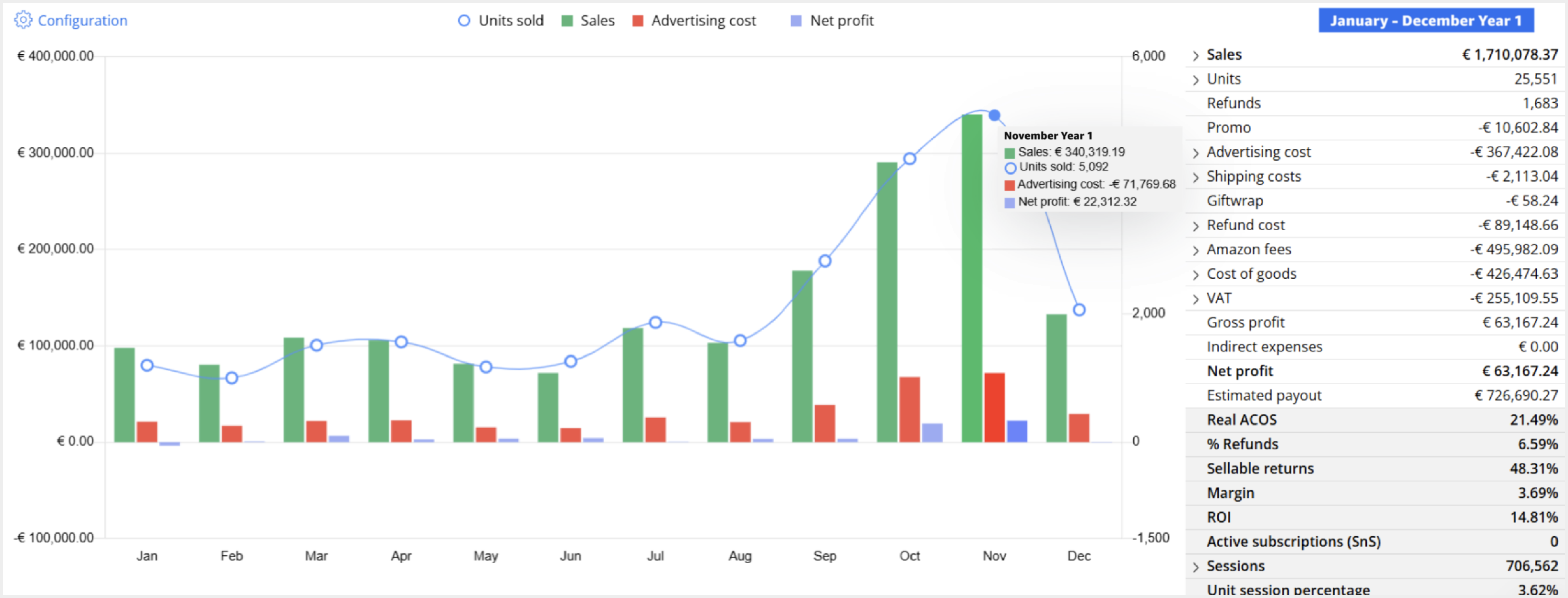
November of year 1 was the brand's highest-revenue month at €340,319. The Black Friday window alone, 20 to 30 November, generated 57% of monthly revenue at a 10.70% margin and a TACoS of 18.31%, below the monthly average and carried by organic momentum rather than ad spend.
YoY April Year 0 vs. May Year 2:
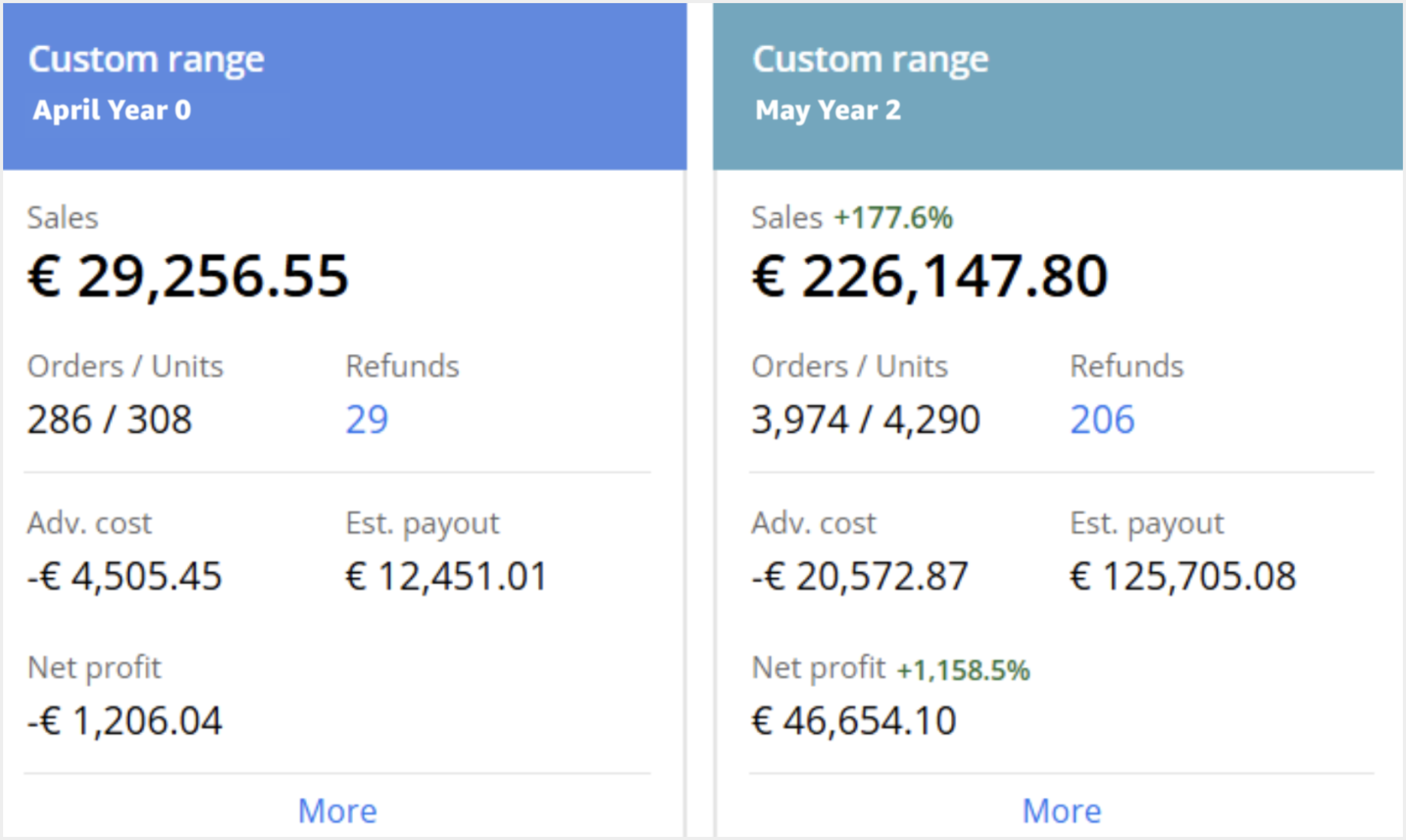
The ad spend row carries the whole strategy in two numbers. In the month before we took over, the account lost €1,206 on €29,257 in sales. By May 2026, the same operation generated €46,654 in profit on €226,148 in revenue, at a 9.1% TACoS.
2 years after AMZ Bees joined:
November of year 1 was the brand's highest-revenue month at €340,319. The Black Friday window alone, 20 to 30 November, generated 57% of monthly revenue at a 10.70% margin and a TACoS of 18.31%, below the monthly average and carried by organic momentum rather than ad spend.
YoY April Year 0 vs. May Year 2:
The ad spend row carries the whole strategy in two numbers. In the month before we took over, the account lost €1,206 on €29,257 in sales. By May 2026, the same operation generated €46,654 in profit on €226,148 in revenue, at a 9.1% TACoS.
2 years after AMZ Bees joined:
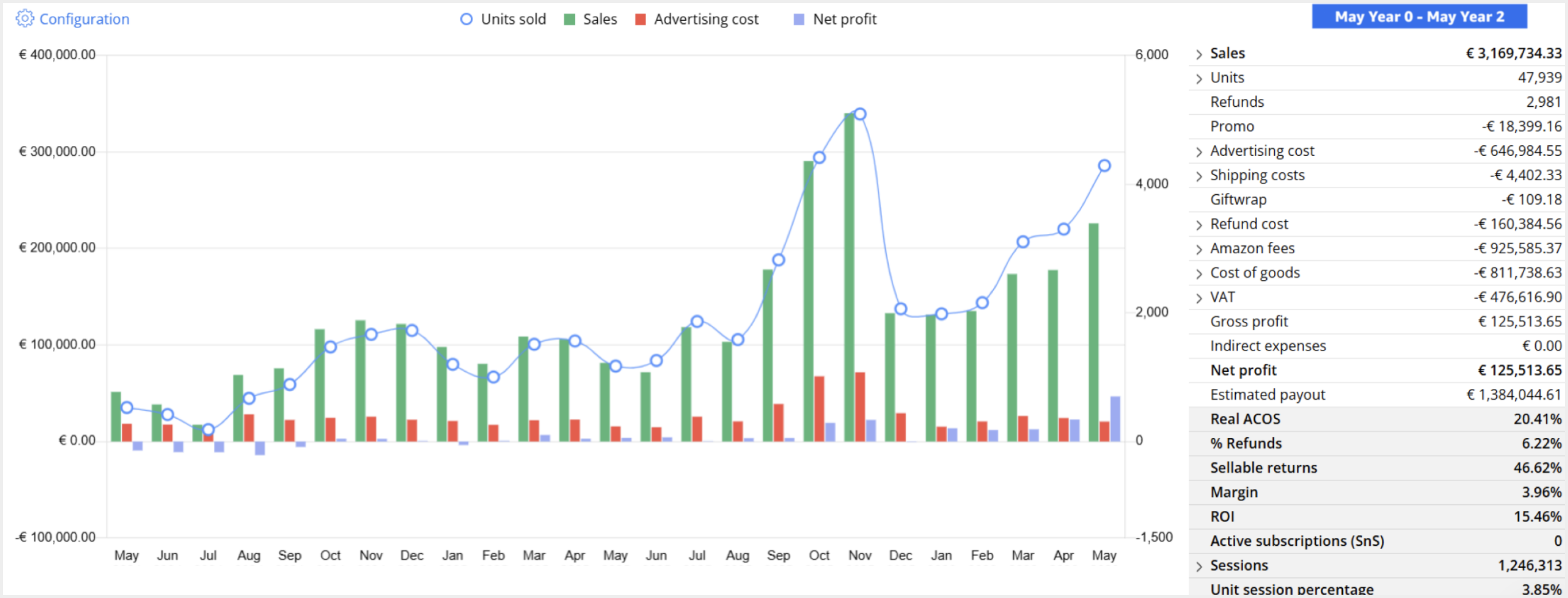
The turnaround held because a handful of decisions stayed in place for two years, and our client had the strategic patience to keep going: we kept what worked and rebuilt the rest, managed to TACoS instead of ACoS, fixed the listings before scaling traffic into them, researched every market before spending in it, and trusted improving signals over an ugly monthly P&L.
The account we manage today is a structurally different business from the one we took over 2 years ago.
The turnaround held because a handful of decisions stayed in place for two years, and our client had the strategic patience to keep going: we kept what worked and rebuilt the rest, managed to TACoS instead of ACoS, fixed the listings before scaling traffic into them, researched every market before spending in it, and trusted improving signals over an ugly monthly P&L.
The account we manage today is a structurally different business from the one we took over 2 years ago.